Memorials in Washington, DC: Iconic and Lesser-Known

Few cities tell America’s story through stone quite like Washington, DC. From the iconic memorials that anchor the National Mall to quieter tributes tucked into parks and neighborhoods, the city offers students a powerful way to connect with the people, events, and ideals that shaped our nation.
For students on a school trip, these memorials make history feel real in a way that goes far beyond the classroom. Walking through these spaces, reading the words carved into stone, and standing in places built to honor moments of courage, sacrifice, and change helps students form a deeper personal connection to the stories they’ve studied. Long after the trip ends, these are often the moments students remember most.
Whether visiting nationally recognized landmarks or discovering lesser-known places of reflection, each memorial offers its own unique perspective on the people and moments that helped shape the United States.
Iconic Memorials in Washington, DC
The Lincoln Memorial
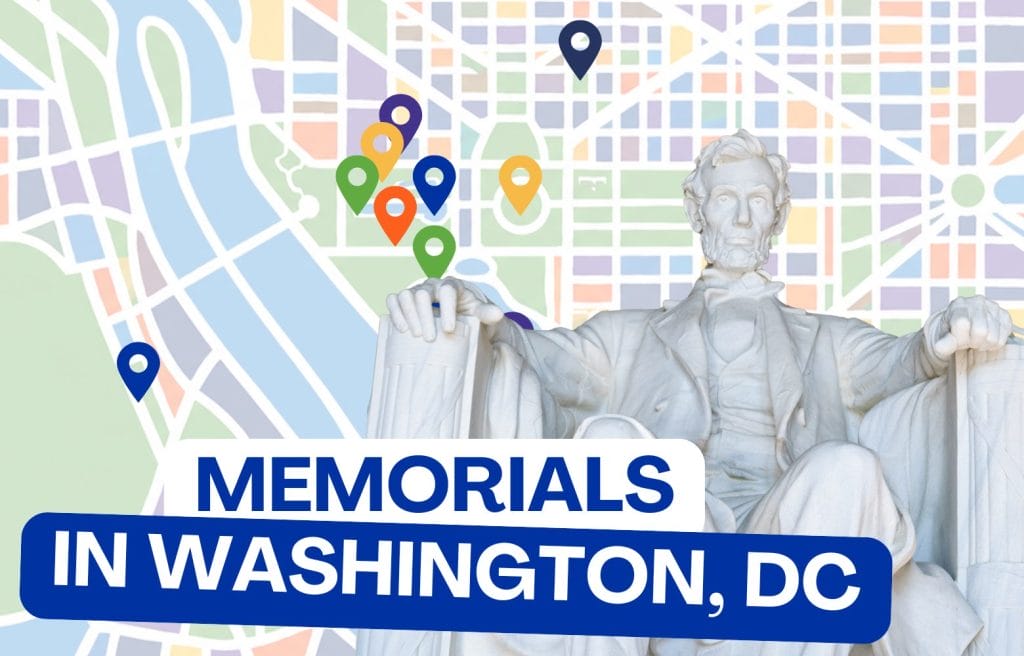
The Lincoln Memorial honors the 16th president inside a Greek temple-style structure overlooking the Reflecting Pool. The massive seated statue of Lincoln sits at the center, flanked on either side by inscriptions of his most famous speeches: the Gettysburg Address and his Second Inaugural Address. The memorial is a powerful reminder of the impact one person can have on the course of history, and the steps themselves carry their own weight: this is where Martin Luther King Jr. delivered the “I Have a Dream” speech in 1963.
The Vietnam Veterans Memorial
The Vietnam Veterans Memorial is a sobering tribute to the men and women who served and sacrificed in the Vietnam War. Its black granite wall is etched with the names of more than 58,000 service members who lost their lives, and the reflective surface allows visitors to see themselves alongside the names. The effect creates a deeply personal connection that often surprises first-time visitors and gives students a quiet space to process what they’re seeing.
The World War II Memorial
The World War II Memorial honors the “Greatest Generation” that served during the war. The design is rich with symbolism, from the 56 pillars representing the U.S. states and territories of that era to the dramatic fountain and reflecting pool at its center. The Freedom Wall, covered in gold stars, commemorates the Americans who lost their lives in the conflict. It’s a thoughtful place to talk with students about the scale of the war and the people behind the statistics.
The Martin Luther King Jr. Memorial
This memorial honors the civil rights leader with a 30-foot statue of Dr. King emerging from the “Stone of Hope,” a direct reference to a line from his “I Have a Dream” speech. Surrounding the statue are walls inscribed with quotes from his speeches and sermons, serving as a lasting reminder of his message of equality, justice, and nonviolent change. The open layout invites students to walk the perimeter and read the quotes at their own pace.
The Korean War Veterans Memorial
This tribute features 19 stainless steel statues of soldiers representing a squad on patrol, arranged in a triangular field. A granite wall etched with images of troops and support personnel runs alongside them, and the figures reflect onto the wall as visitors move past. The memorial is a stark reminder of the human cost of war and the sacrifices made by those who served in a conflict that’s often overlooked in classroom history lessons.
The National 9/11 Pentagon Memorial
The National 9/11 Pentagon Memorial honors the 184 lives lost during the September 11, 2001 attack on the Pentagon and aboard American Airlines Flight 77. Located at the exact site where the plane struck the building, the memorial features 184 illuminated benches arranged by the ages of the victims, creating a powerful and deeply personal space for reflection. For students, visiting the memorial offers an opportunity to better understand the lasting impact of 9/11 and reflect on themes of sacrifice, resilience, and national unity.
The U.S. Marine Corps War Memorial
The U.S. Marine Corps War Memorial, often referred to as the Iwo Jima Memorial, is located in Arlington, Virginia overlooking Washington, DC near Arlington National Cemetery. Inspired by the iconic photograph of Marines raising the American flag on Iwo Jima during World War II, the memorial honors all Marines who have given their lives in service to the United States since 1775.
The Thomas Jefferson Memorial
The Thomas Jefferson Memorial is located along the Tidal Basin and honors Thomas Jefferson, principal author of the Declaration of Independence and third president of the United States. Inspired by classical Roman architecture, the memorial features a towering bronze statue of Jefferson surrounded by passages from his writings on liberty, democracy, and individual rights.
The Franklin Delano Roosevelt Memorial
The Franklin Delano Roosevelt Memorial is located along the Tidal Basin in West Potomac Park and tells the story of one of the most transformative periods in American history through the life and leadership of President Franklin D. Roosevelt. Spanning four outdoor rooms that represent each of Roosevelt’s presidential terms, the memorial features waterfalls, sculptures, historic quotations, and scenes from the Great Depression and World War II.
Lesser-Known Memorials in Washington, DC
The iconic memorials draw the crowds, but several smaller sites offer just as much depth for groups willing to step off the main path.
The World War I Memorial
The National World War I Memorial honors the Americans who served and sacrificed during World War I while recognizing the lasting impact the conflict had on the United States and the world. Located along Pennsylvania Avenue in the heart of Washington, DC, the memorial features powerful artwork, meaningful inscriptions, and spaces designed for reflection and remembrance.
The District of Columbia War Memorial
Tucked into a quiet section of West Potomac Park, the DC War Memorial honors the 26,000 residents and citizens of Washington, DC who served in World War I. The simple yet elegant structure features 12 Doric columns supporting a circular dome, with the names of District residents who lost their lives inscribed at its base. It’s a peaceful spot for reflection and remembrance, well away from the busier sites on the Mall.
The Albert Einstein Memorial
The Albert Einstein Memorial is a larger-than-life bronze statue of the famed physicist sitting on a granite bench outside the National Academy of Sciences. Visitors are encouraged to climb up and sit beside him, making it a popular spot for photos and a memorable stop for student groups. The memorial also features a star map at Einstein’s feet, depicting the planets and stars as they were on the night of the memorial’s dedication in 1979.
The Titanic Memorial
Located in the Southwest Waterfront neighborhood, the Titanic Memorial is dedicated to the men who gave up their seats in lifeboats so that women and children could survive the sinking in 1912. The striking granite figure stands with arms outstretched, depicting “Self Sacrifice.” It was designed by Gertrude Vanderbilt Whitney, who later founded the Whitney Museum of American Art, and was funded largely by women across the country who donated up to $1 each. The memorial was dedicated in 1931 and moved to its current location in 1968.
The George Mason Memorial
Located near the Tidal Basin in West Potomac Park, the George Mason Memorial honors one of the most influential yet often overlooked Founding Fathers in American history. George Mason was the principal author of the Virginia Declaration of Rights, a document that helped inspire both the Declaration of Independence and the United States Bill of Rights. Known for his strong support of individual liberties, Mason famously refused to sign the U.S. Constitution because it lacked specific protections for personal freedoms. Dedicated in 2002, the memorial features a bronze sculpture of Mason seated among landscaped gardens and engraved quotations reflecting his views on liberty, government, and human rights, creating a peaceful space for visitors to reflect on his lasting impact on American democracy.
Planning Your Memorial Visit
A little preparation can turn a memorial visit from a simple sightseeing stop into one of the most meaningful moments of a student’s trip to Washington, DC.
- Time it right. While most memorials are open 24 hours a day, visiting in the early morning or evening often provides a quieter atmosphere, cooler temperatures, fewer crowds, and better opportunities for reflection and photography.
- Build in pre-trip context. Even a brief classroom discussion or pre-trip activity can help students better understand the historical significance behind each memorial. When students already recognize the names, events, and themes connected to a site, the experience becomes far more personal and impactful once they stand there in person.
- Set expectations with students. Memorials are spaces of remembrance, reflection, and respect. Setting expectations ahead of time helps students understand the importance of appropriate behavior while also encouraging them to engage more thoughtfully with what they are seeing.
- Encourage active observation. Giving students something specific to look for at each memorial helps create deeper engagement. Whether it’s locating a name on the Vietnam Veterans Memorial, identifying symbolism within the World War II Memorial, or reflecting on a quote at the Martin Luther King, Jr. Memorial, intentional observation helps transform the experience from a quick walkthrough into a lasting educational moment.
Bringing Washington, DC’s Memorials to Your Students
Few experiences bring history to life for students quite like standing in the places where America’s story is remembered and honored. From iconic landmarks on the National Mall to quieter memorials tucked throughout the city, each site offers students a deeper connection to the people, sacrifices, and moments that shaped the nation. Exploring both the well-known memorials and the lesser-visited spaces helps students see history from multiple perspectives while creating meaningful moments of reflection, discussion, and discovery along the way.
If you’re planning a Washington, DC school trip, NationsClassroom can help you build an itinerary that transforms these historic places into unforgettable learning experiences. From customized planning and curriculum-connected experiences to on-tour support and seamless logistics, our team is here to help educators and students experience Learning That’s Lived every step of the way.