Top Tour Sites for East Coast Student Trips

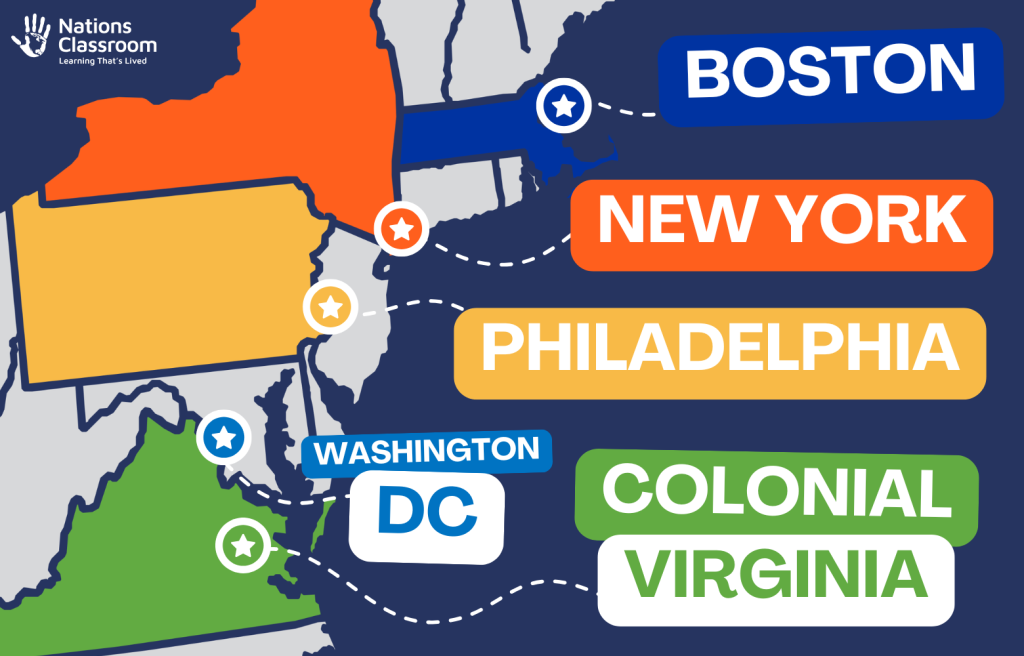
Every NationsClassroom school trip is designed around your students, your curriculum, and your learning objectives. Rather than following a one-size-fits-all itinerary, each educational tour is customized to give students meaningful, hands-on experiences that reinforce what they’re learning in the classroom. To help you explore what’s possible, we’ve highlighted some of the destinations our team recommends most often across five iconic East Coast cities. From standing where the Declaration of Independence was signed in Philadelphia to experiencing living history in Colonial Williamsburg, each stop helps students connect with the people, places, and moments that continue to shape our nation.
Boston: Where History Comes to Life
Boston Tea Party Ships & Museum
The Boston Tea Party Ships & Museum is another great nautical adventure for your students, where they can step back in time and join American revolutionaries as they fight against British tyranny. Start your visit in the Meeting House, where students take part in a colonial town hall meeting led by Samuel Adams, then join the Sons of Liberty as they storm the British ships and dump tea overboard, and learn about the aftermath of the Boston Tea Party through a multi-sensory film in Minuteman Theater.
Plimoth & Pawtuxet Museum
Plimoth & Pawtuxet Museum is one of the most popular destinations in New England, offering a living, interactive museum complex that tells the interwoven stories of the Pilgrim settlers and the native Wampanoag people. The permanent outdoor exhibit includes a 17th-century English village, Wampanoag Indian site, gristmill, and craft center that recreate the sights, sounds, and stories of early America, and you can add on a traditional Pilgrim dinner for your group or join a Dead of Night Ghost Tour in Plymouth to learn about local legends, mysteries, and folklore.
Bunker Hill Monument & Museum
Start your day with a hike up to the Bunker Hill Monument and a tour in the Bunker Hill Lodge that adjoins the Monument to learn about the 1775 Battle of Bunker Hill, featuring the statue of Joseph Warren, portraits, and a Revolutionary War cannon, The Adams. For an unforgettable perspective, students can climb all 294 steps to the top of the monument and take in sweeping views of Boston and Charlestown. Student groups can also visit the Bunker Hill Museum across the street to learn about the Battle of Bunker Hill, the construction of the Bunker Hill Monument, and the history of the Charlestown neighborhood.
Boston Duck Tour
A land and water experience awaits your group as you board an amphibious vehicle for sightseeing throughout Boston, including several attractions along the Freedom Trail such as Trinity Church, Boston Common, Beacon Hill, the Boston State House, Faneuil Hall, and Quincy Market. After exploring Boston’s historic landmarks by land, your group will transition to the water as the tour continues with an amphibious cruise along the Charles River.
The USS Constitution
Step aboard “Old Ironsides,” the world’s oldest commissioned warship afloat, and explore the decks where sailors fought and lived during the War of 1812. The old warship, manned by U.S. Navy personnel, has remained undefeated since its launch in 1797, and the museum offers hands-on, interactive exhibits that teach students about the ship’s construction, history, and life on the high seas during the 1700s.
Philadelphia: Birthplace of American Democracy
The National Constitution Center
The National Constitution Center brings history to life for students through its three signature attractions: Freedom Rising, a multimedia theatrical production; The Story of We the People, a hands-on exhibit with artifacts and activities; and Signers’ Hall, featuring 42 life-sized bronze statues of the men who signed the Constitution. The Center also offers the incredible Interactive Constitution online tool, which teachers can use in the classroom and students can access from home to better understand the Constitution.
Independence Hall
Just a few steps away from the National Constitution Center, Independence Hall is where the Second Continental Congress signed the Declaration of Independence in 1776 and the Constitutional Convention created and signed the United States Constitution eleven years later. A short guided tour through the inside of the building will give students a look at the Assembly Room and other first-floor rooms, but tickets often sell out six months to a year in advance, so be sure to let your account representative know if you’re interested in taking a tour.
The Liberty Bell
Conveniently located next to Independence Hall, the Liberty Bell Pavilion has exhibits telling the history of the Liberty Bell, covering topics like its founding, use by abolitionists and suffragettes, and a 10-minute film about the Bell. The visit culminates with a view of the cracked Liberty Bell itself, where students can take photos and learn more by talking to a Park Ranger during their visit.
Museum of the American Revolution
At the Museum of the American Revolution, students can walk alongside Patriots and Loyalists as they trace the American Revolutionary War from the unrest of Boston colonists to the Constitutional Convention, guided by four core questions. During their visit, students can see George Washington’s war tent, stand beneath the Boston Liberty Tree, and take a look at authentic revolutionary weapons.
The Franklin Institute
Named for Philadelphia’s greatest statesman and America’s first scientist, the Franklin Institute pays tribute to Benjamin Franklin’s “spirit of inquiry and discovery” through incredible hands-on experiences that teach students about science, technology, and research. Some of their most popular exhibits include Your Brain, a two-story “neural network” that shows how bodies communicate with brains, and SportsZone, which explores the science of the human body, laws of motion, and technical innovation in athletics. Student groups can also visit the Planetarium, IMAX theater, or live science experiment for a fee.
Washington D.C.: Nation’s Capital and Living Classroom
National Mall & Memorials
Walk the grounds where history was made and pay tribute to the individuals who shaped our nation at some of Washington, DC’s most iconic memorials. Stand at the Lincoln Memorial, where Dr. Martin Luther King Jr. delivered his historic “I Have a Dream” speech, visit the Vietnam Veterans Memorial to honor those who served and sacrificed, and explore landmarks including the Washington Monument, the World War II Memorial, and the Reflecting Pool. Together, these sites give students the opportunity to reflect on the people, events, and ideals that continue to define the United States. Looking to explore even more memorials in Washington, DC? Check out our guide to the city’s iconic and lesser-known memorials for additional recommendations.
Smithsonian Museums
Explore the world’s largest museum complex, where every museum offers a new way to experience history, science, innovation, and culture. Students can stand beneath towering dinosaur fossils and see the legendary Hope Diamond at the Natural History Museum, discover the Wright brothers’ original 1903 Flyer and the Apollo 11 command module at the Air and Space Museum, or explore the nation’s story at the American History Museum. There, they’ll encounter iconic artifacts like the original Star-Spangled Banner and the top hat Abraham Lincoln wore on the night of his assassination, bringing the people and moments that shaped America to life.
U.S. Capitol Building
Step inside the heart of American democracy with a visit to the U.S. Capitol, where Congress meets to debate, shape, and pass the laws that govern the nation. Students can begin at the Capitol Visitor Center with an introductory film before exploring the historic Crypt, the iconic Rotunda, and National Statuary Hall. Many groups also arrange meetings with their U.S. Representative or Senators, giving students a unique opportunity to learn firsthand about the legislative process and the role elected officials play in representing their constituents.
The White House
Snap a photo in front of the iconic residence of the President of the United States and learn about its rich history and significance. While tours of the White House interior are limited, students can still explore the White House Visitor Center, which offers exhibits on the architecture, furnishings, and famous events that have taken place within its walls.
Mount Vernon
Visit George Washington’s beloved estate and explore the mansion, gardens, and museum dedicated to the life and legacy of the nation’s first president. Students can tour Washington’s home, watch historical interpreters demonstrate 18th-century crafts and farming techniques, and pay their respects at Washington’s tomb. The Donald W. Reynolds Museum and Education Center offers interactive exhibits and films that bring Washington’s story to life, from his early days as a surveyor to his leadership during the Revolutionary War and his presidency.
New York City: A World of Culture and Discovery
Statue of Liberty & Ellis Island
Like the millions of immigrants who arrived in New York Harbor in search of the American Dream, a visit to the Statue of Liberty offers students a powerful introduction to the nation’s immigration story. Depending on your itinerary, your group can take a ferry to Liberty Island to walk around the pedestal of this iconic landmark before continuing to Ellis Island to explore the National Museum of Immigration and learn about the experiences of those who entered the United States through its historic halls. If time doesn’t allow for a full island visit, a sightseeing cruise through New York Harbor still provides unforgettable views of the Statue of Liberty while giving students the opportunity to learn about its enduring symbolism and significance.
Guided Walking Tours
One of the best ways to experience New York City is on foot. NationsClassroom’s expert tour guides lead engaging walking tours through some of the city’s most iconic areas, including Central Park, the Financial District, Midtown, Fifth Avenue, Upper Manhattan, and New York’s diverse ethnic boroughs. Along the way, students discover the architecture, history, culture, and stories that make each area unique, gaining a deeper understanding of how New York has evolved into one of the world’s most influential cities.
Broadway
For many student groups, an evening on Broadway is the perfect way to experience New York City’s world-renowned performing arts scene. The experience often begins in the bright lights of Times Square before students enjoy dinner and a Broadway performance. With more than 40 professional theaters offering productions that span history, literature, music, and contemporary storytelling, there’s a show to fit nearly every group’s interests and budget. Your account representative can help you select the performance that best complements your itinerary and educational goals.
Observation Deck
Seeing New York City from above gives students an entirely new perspective on one of the world’s most iconic skylines. Groups can choose from several unforgettable observation decks, including the Empire State Building, Top of the Rock at Rockefeller Center, One World Observatory, and The Edge, the highest outdoor sky deck in the Western Hemisphere. From these incredible vantage points, students can take in panoramic views of famous landmarks, the city’s unique layout, and the sheer scale of New York City.
9/11 Memorial Plaza & Museum
In addition to visiting the 9/11 Memorial Plaza, many student groups spend time exploring the nearby 9/11 Memorial & Museum, where educational programs for students in grades 3-12 bring the events of September 11, 2001, into meaningful context. Through powerful artifacts, firsthand accounts, and interactive exhibits, students gain a deeper understanding of the attacks, the lives that were lost, and the resilience that followed. The museum helps student groups understand how the attacks reshaped the United States and continue to influence the nation’s history, security, and culture.
Colonial Virginia: Stepping Back in Time
Colonial Williamsburg
Colonial Williamsburg gives students the opportunity to experience the sights, sounds, and stories of 18th-century America firsthand. Along Duke of Gloucester Street, historic taverns, trade shops, homes, and interpreters in period clothing bring the colonial capital to life, helping students better understand the people, ideas, and daily experiences that shaped the road to independence. After a full day of exploring, groups can extend the experience into the evening with immersive programs such as Trial of a Patriot, To Hang a Pirate, or Cry Witch, or take part in a nighttime ghost tour through the historic area.
Jamestown Settlement
Jamestown Settlement brings the story of America’s first permanent English colony to life through immersive exhibits and historical interpretation. Students explore the founding of Jamestown from the perspectives of the English settlers, the Powhatan Indians, and the African slaves whose arrival marked the beginning of a lasting chapter in American history. The experience includes expansive museum galleries as well as outdoor recreations of the 1610 James Fort, a Powhatan village, and full-scale replicas of the Susan Constant, Godspeed, and Discovery, the three ships that carried the first English settlers to Virginia. Together, these experiences help students better understand the challenges, cultures, and interactions that shaped early colonial America.
American Revolution Museum at Yorktown
The American Revolution Museum at Yorktown brings the story of the nation’s founding to life through immersive exhibits, engaging storytelling, and hands-on experiences. Students can explore galleries featuring hundreds of artifacts that trace the road to independence before experiencing a powerful 4D theater presentation that places them in the midst of the 1781 Battle of Yorktown. Outside, living-history areas recreate a Continental Army encampment and an 18th-century farm, where historical interpreters demonstrate military drills, musket firings, and daily colonial life while sharing the experiences of soldiers, civilians, and the enslaved people whose lives were shaped by the American Revolution.
St. John’s Church
St. John’s Church in Richmond is where Patrick Henry delivered his legendary “Give Me Liberty, or Give Me Death!” speech, one of the defining moments leading up to the American Revolution. During a guided tour, students learn about the church’s history, Virginia’s pivotal role in the fight for independence, and the spirited debates of the Second Virginia Convention that helped shape the nation’s future. For an even more immersive experience, groups can attend a live reenactment of Patrick Henry’s famous speech, offering students the opportunity to witness one of America’s most influential moments brought vividly to life.
Monticello
Explore the mountaintop home of Thomas Jefferson, principal author of the Declaration of Independence and the nation’s third president. As students tour the beautifully preserved house, they can see Jefferson’s ingenious inventions, original furnishings, and the spaces where he lived, worked, and shaped many of the ideas that influenced the young nation. Beyond the mansion, students can explore the historic gardens, Mulberry Row, and exhibits that tell the stories of the hundreds of enslaved people who lived and labored at Monticello, providing a deeper understanding of both Jefferson’s remarkable achievements and the complex legacy of America’s founding.
Planning Your Perfect East Coast Student Tour
We believe that experiential learning is the key to fostering a lifelong love of discovery. That’s why we’re dedicated to providing exceptional educational travel experiences that inspire, engage, and transform.
Every NationsClassroom journey is tailored to your students and curriculum, creating meaningful opportunities to experience the history, science, culture, and creativity they’re learning about in the classroom.
Explore our destinations to see how these sites come together on a full itinerary: Boston, Philadelphia, Washington D.C., New York City, and Colonial Virginia.